
Be Careful What You Read On The Internet (Because It Might Be Bullsh*t)

I’m a little conflicted about writing this article. Not because I don’t believe in the message I am trying to impart, but because I don’t want it to come across like I am criticizing a fellow writer.
Every day, in my email inbox, I receive newsletters from various “men’s interest” sites. These emails typically have collections of articles about style, sports, watches, cars… you get the idea.
The other day, I received an email from the site Cool Material promoting an article about Cary Grant. Naturally, I clicked the link and read the article. You can find the article here.
In the article, Mr. Lanny Fuller writes that he recently saw a bunch of photos of Cary Grant relaxing at home and was so taken by Grant’s easy style that he wanted to recreate that himself. Basically, we all get so focused on what to wear when we go out that we sometimes lose sight of the joy of dressing to stay in.
Dressing for nobody but yourself has value.
On those points, I do not disagree. I actually quite enjoyed the article, as Mr. Fuller included numerous shots of himself lounging around his house in a very nice tennis sweater and roomy, pleated trousers, in an attempt to recreate the photos he had seen of Cary Grant. He even included those photos to show where his inspiration came from.
There was just one small problem…
The man in the photos was not Cary Grant.
Here are the photos of “Cary Grant” included in Mr. Fuller’s article…


That man was actually Cary Grant’s longtime roommate (wink-wink), fellow actor, Randolph Scott.
Now, there is nothing wrong with emulating Scott’s look over Grant’s. But this appears more than just a simple mix-up.
Mr. Fuller does not, at any point, profess to be a fan of Cary Grant, so I don’t blame him for not knowing what Grant looked like (even though Grant is one of the most famous actors in history). But it does seem like quite an oversight to devote an entire article to an individual and not know even the first thing about him.
Mr. Fuller says that his inspiration came from an Architectural Digest article about Grant. You can find that article here. That article has the exact photos that Mr. Fuller used in his own article. Confusingly, when Mr. Fuller used them in his article, he cropped out the real Cary Grant and only featured Randolph Scott, as you can see below…

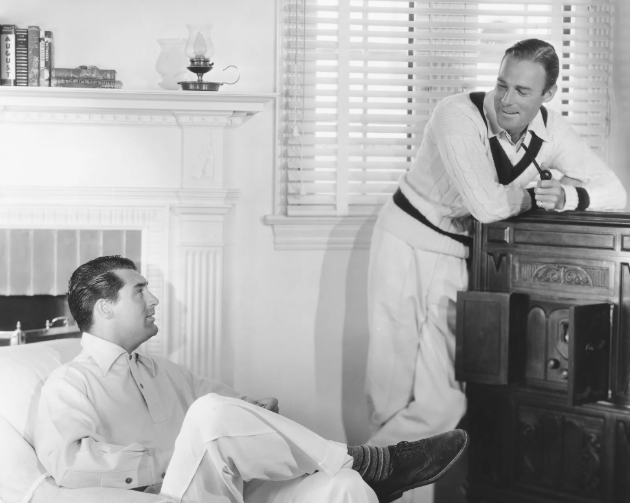
So, it’s not like he Googled “Cary Grant at home” and related pictures of JUST Randolph Scott showed up (which would make sense) and he used those, by accident. That would be an understandable mix-up. No, he perused an entire article with numerous pictures of the real Cary Grant and ended up using the pictures of his roommate instead.
Ok, we all make mistakes. And it’s not a big deal that he used the wrong guy in his photos because the overall message of his article still made sense regardless of whether it was Scott or Grant providing the inspiration. I am sure I have made a ton of mistakes in my articles over the years, and it’s only because my site doesn’t have nearly the reach of Cool Material that I haven’t been made aware of those mistakes.
To be crystal clear, I agree with the message of Mr. Fuller’s article and I enjoyed reading it. My issue is not with him.
My issue is with Cool Material.
They blasted out a newsletter email promoting an article about Cary Grant… when the article didn’t feature Grant at all. It’s clear there was no process of checks in place before that email was sent. There wasn’t one person in the marketing department who knew what Cary Grant looked like? No one who was vetting an article about menswear had any clue what the consensus “most stylish man ever” looked like?
This is what I mean by the title of this article. Be careful what you read on the internet because anyone can post anything and claim to be an authority. I’ve lost track of how many times I have seen things posted on menswear sites and forums by people who look and act very confidently and I go “Nope, that’s wrong. Totally, verifiably wrong.”
But someone just starting out in the world of menswear is not armed with that knowledge yet. They might believe something erroneous simply because it was said by someone with confidence.
When it comes to Cool Material, would I trust anything they say about menswear now that I know that they clearly have no internal editing process before their emails go out? Probably not.
Look, I am in marketing so I know that this article had to pass through A LOT of hands. No one caught it before it went out the door which means one of two things happened (neither one good): Either no one actually read the article before it was posted and promoted in a newsletter to thousands of subscribers or it WAS read before it was posted/promoted but no one at Cool Material knows enough about menswear to recognize one of the most famous, well-dressed men of the past century. That speaks to a startling lack of basic knowledge on a subject they are trying to position themselves as an authority on.
Does my newfound distrust transfer to their articles about sports or watches or relationships or anything else? You bet.
If the people vetting the menswear articles have no idea what Cary Grant looks like, then I don’t believe they know what they’re talking about on literally any other topic.
Lastly, Cool Material posted the article over a week ago and it still has not been corrected. All they would have to do is a “Find/Replace” on the article and swap out Grant’s name for Scott’s and everything would be fine.
So, for ever after there will be an article floating around the internet, from a reputable site, claiming Randolph Scott was Cary Grant.
Is the article all that important in the grand scheme of things? No. But it highlights why it’s important to keep a critical eye when you’re online. Don’t let the window-dressing of a fancy site trick you into thinking that what they’re posting is automatically correct.
In this digital age (especially with the rise of AI), we all need to be doing our due-diligence when it comes to seeking accurate information.
This is even more important for young people to understand, especially children who are starting to use the internet. They might blindly trust a source without casting an important critical eye on what they are consuming.
Remember as kids when we would stand in line at the grocery store with our parents and look at the ridiculous tabloids on the newsstand? Sure, we might have realized that the stories weren’t real, but some kids were definitely duped since it was an actual newspaper in a real store. Our parents had to tell us that all that stuff was fake. We need to do that with our kids as it relates to the internet.
Whenever I use the internet to look something up in front of my kids, if I come across something that doesn’t immediately pass the smell test, I voice my skepticism so they can hear it. I’ll say something like “That doesn’t sound correct. Let me look it up on a more reputable source.”
I say that so that they understand that the internet isn’t always correct and to always validate the information they receive.