
How To Wear Loafers With A Suit

One of the many menswear “rules” floating around the internet is “don’t wear loafers with a suit”.
Well, today I am going to give you a rundown on how you can successfully pull off that look.
The rule about not wearing loafers with a suit was created way back in the days of the dinosaurs when loafers were considered by everyone to be casual shoes. The “spirit” of the rule was basically “don’t wear items of clearly clashing formality”.
Today’s equivalent would be something like “don’t wear work boots with a suit”.
But then the world evolved and people’s views of what was “formal” changed. Nowadays, most people consider loafers to be “dress shoes”. Super-fancy dress shoes? Maybe not. But dress shoes, nonetheless.
So, you now have two main camps of people. People who still adhere to the old rule that says that loafers should never be worn with a suit, and people who think that any loafer is ok with a suit.
Both camps are missing the nuance.
Now, to be clear, when I say “suit” in this context, I am referring to a regular ol’ business suit. Fairly dark, conservative, and formal. Other kinds of suits, like tweed suits, cotton-poplin suits, or seersucker suits kind of live in their own separate category and the styling of them isn’t quite as rigid as with regular business suits. For those kinds of alternative suits, most loafers (even quite casual-leaning styles) look perfectly fine, in many cases.
For this article, I’m talking about the kind of suit you’d wear to an interview, wedding, or important work meeting.
Before we really begin, I want to be clear that while wearing loafers with a suit can absolutely work, it is never the ideal choice. It’s always better to wear proper lace-ups with a suit. But if you choose to go with loafers over lace-ups, here is how to do it well…
The most important thing to consider when choosing loafers to wear with a suit is the loafers’ formality. Since loafers were considered casual, originally, you need to make sure that the loafers in question sit on the more formal end of the formality spectrum.
What does that mean?
Well, “formal” usually means dark, refined in shape, and free from ornamentation.
A regular penny loafer wouldn’t meet these criteria with its brown color, boxy shape, beef-roll ornamentation, (usually) thicker soles, and obvious stitching.
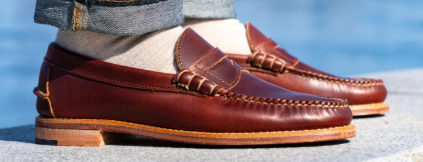
But a penny loafer in black, with a longer vamp, narrower toe-box, and single-thickness soles? Those could absolutely work with a suit.
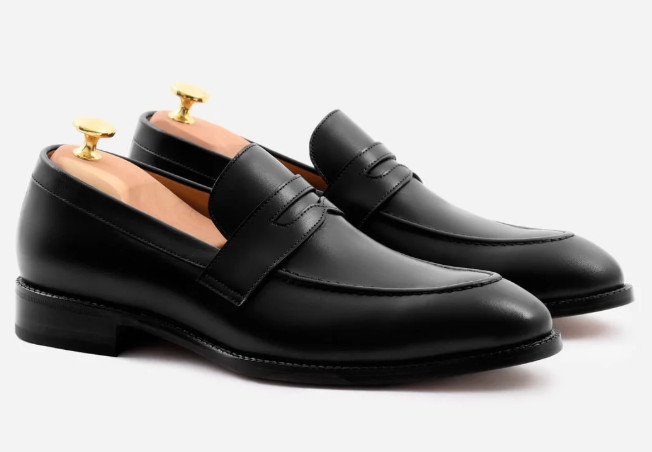
Even though both examples are penny loafers, one works and one doesn’t.
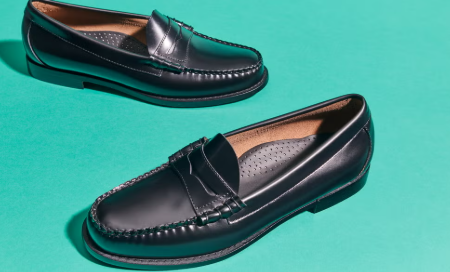
It’s not so much the kind of shoe that matters, but the impression the shoe gives off. Something like a Bass Weejun gives off “strolling around campus in the fall” vibes. You think of rumpled khakis, chunky sweaters, and tweed.
Something like a Gucci horsebit loafer, on the other hand, gives off totally different vibes, even though they have a similar shape to the Weejuns. The Guccis make me think of cocktails at the hotel bar after work.
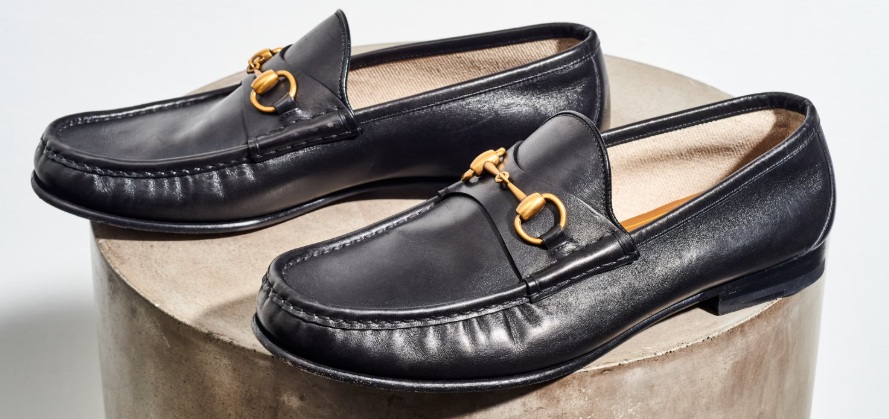
They’re both loafers but I wouldn’t wear the Weejuns with a regular suit. The Guccis? Absolutely (although I wouldn’t spend the money for them).
In my opinion, the most important feature to look for in a more “formal” loafer is color. If it’s black, you’re already most-of-the-way there. After color, you can look to the other features like shape and ornamentation.
I’ll do another kind of loafer, a tassel loafer, in this case, to illustrate my point.
Even though a tassel loafer has a pretty big and obvious ornament (the tassels) which brings down the formality, a black tassel loafer can be worn with a suit, while a brown one really can’t. The combination of the brown color and the aforementioned ornamentation is too casual for a suit. Take a look at the black versus brown examples below…
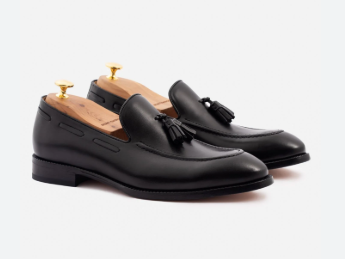
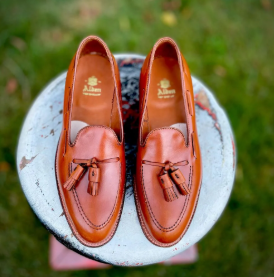
The gist of a “rule” like this is to not draw attention to a part of your outfit that doesn’t go with the rest. When wearing loafers with a suit, a too-casual loafer will make people immediately look down at your feet upon seeing you because the pairing of a formal suit with an informal shoe is too glaring to go unnoticed.
It’s the same idea for the rule that states that your socks should match your trousers. They don’t have to “match” exactly… they just have to be in the same general color neighborhood as your pants and shoes so that they don’t draw attention.
It’s the same with the shoes you wear with a suit.
You want a fairly clean, uninterrupted line from the top of your body to the bottom. In something like a navy business suit, a black, sleek loafer accomplishes 99% of what a lace-up, oxford shoe does. A chunky, moccasin-style loafer, as an example, would visually break up the outfit, in a bad way.
So, to those two camps from earlier, just because a shoe is a loafer doesn’t automatically mean it CAN be worn with suits. And just because a shoe is a loafer doesn’t automatically mean it CAN’T be worn with suits.
But it’s not as hard as many people make it out to be.
Does the shoe look dark and sleek? If so, go ahead and wear it with a suit.
Does the shoe look like a boat shoe or moccasin or something you could feasibly imagine being paired with shorts? If so, then save it for the weekend.
Too often with menswear “rules”, we get so bogged down in following them to the letter that we miss what the original “point” of the rule was to begin with (when it was created sometimes over seventy years ago).
It’s like that “no brown in town” rule. People think that that rule means you literally shouldn’t wear brown shoes in a city, like London or New York. But they’re missing the point. When that rule was created, people usually only wore brown shoes when they were engaging in casual, or sporting, pursuits. The brown shoes were usually accompanied by rough tweed jackets and cloth caps.
“No brown in town” back then was just shorthand for “don’t wear casual clothes when engaging in serious/formal business”. It’s essentially “don’t wear athleisure to the office”.
And when you think about it, it’s pretty much the same sentiment as the “don’t wear loafers with a suit” rule, namely, don’t combine things of clashing formality.
Menswear, and style in general, is much more fun and much less stressful when you realize that all these “rules” are more like general guidelines. Since many were created a LONG time ago, you need to take a step back from them and think about what they’re actually trying to say, instead of following them exactly.

So, even though they are never the ideal choice, you absolutely CAN wear loafers with a suit.